Every design leader eventually gets asked the same question: “How do you evaluate your designers?”
And every design leader hates it. Because the honest answer is usually some version of “I look at their work and I just… know?” Which is not exactly the kind of rigorous framework that gets you budget for headcount.
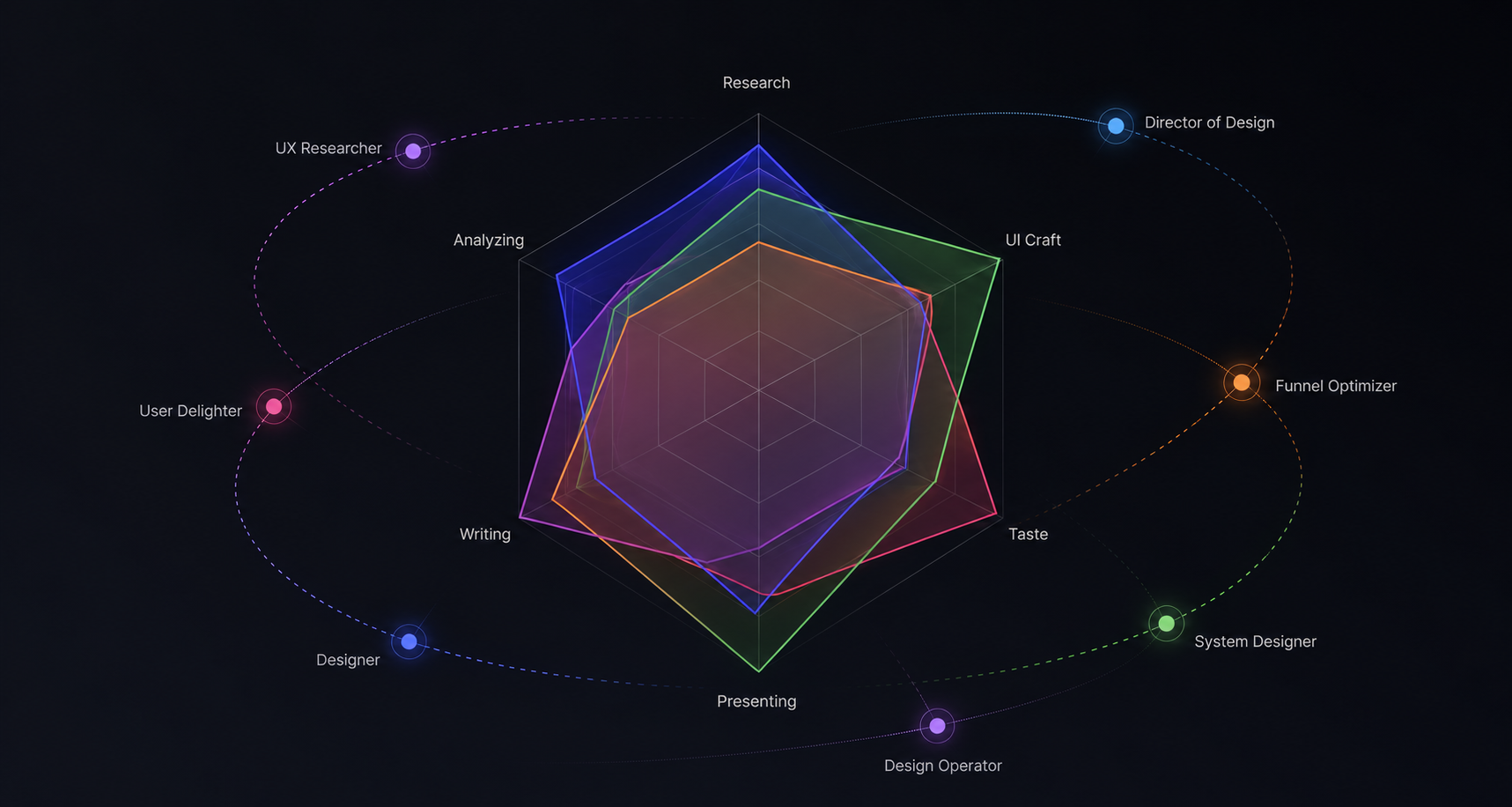
So I built one. Six skills, one hexagonal radar chart per person, and a surprisingly clear picture of what your team actually looks like when you overlay those graphs one on top of the other.
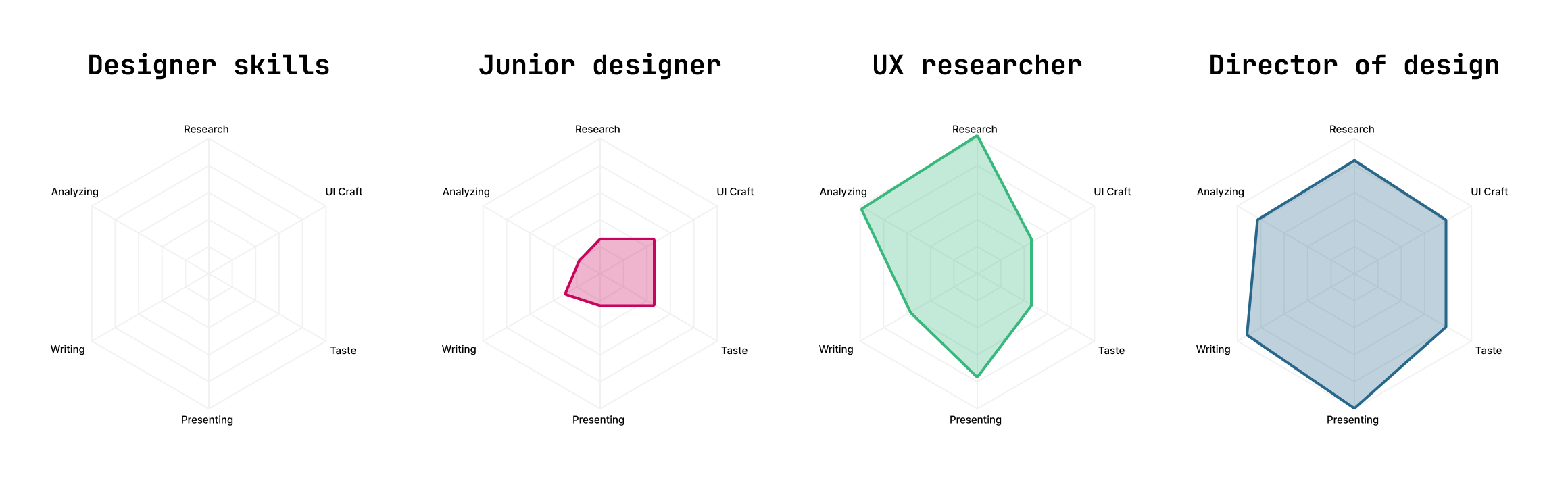
Here’s the framework. Every designer, regardless of their title or seniority, can be mapped against six dimensions:
Plot those six on a radar chart and you get a shape. That shape tells you a lot.
Here’s where it gets interesting. Forget titles for a second. When I look at what designers actually do on a team, I see archetypes:
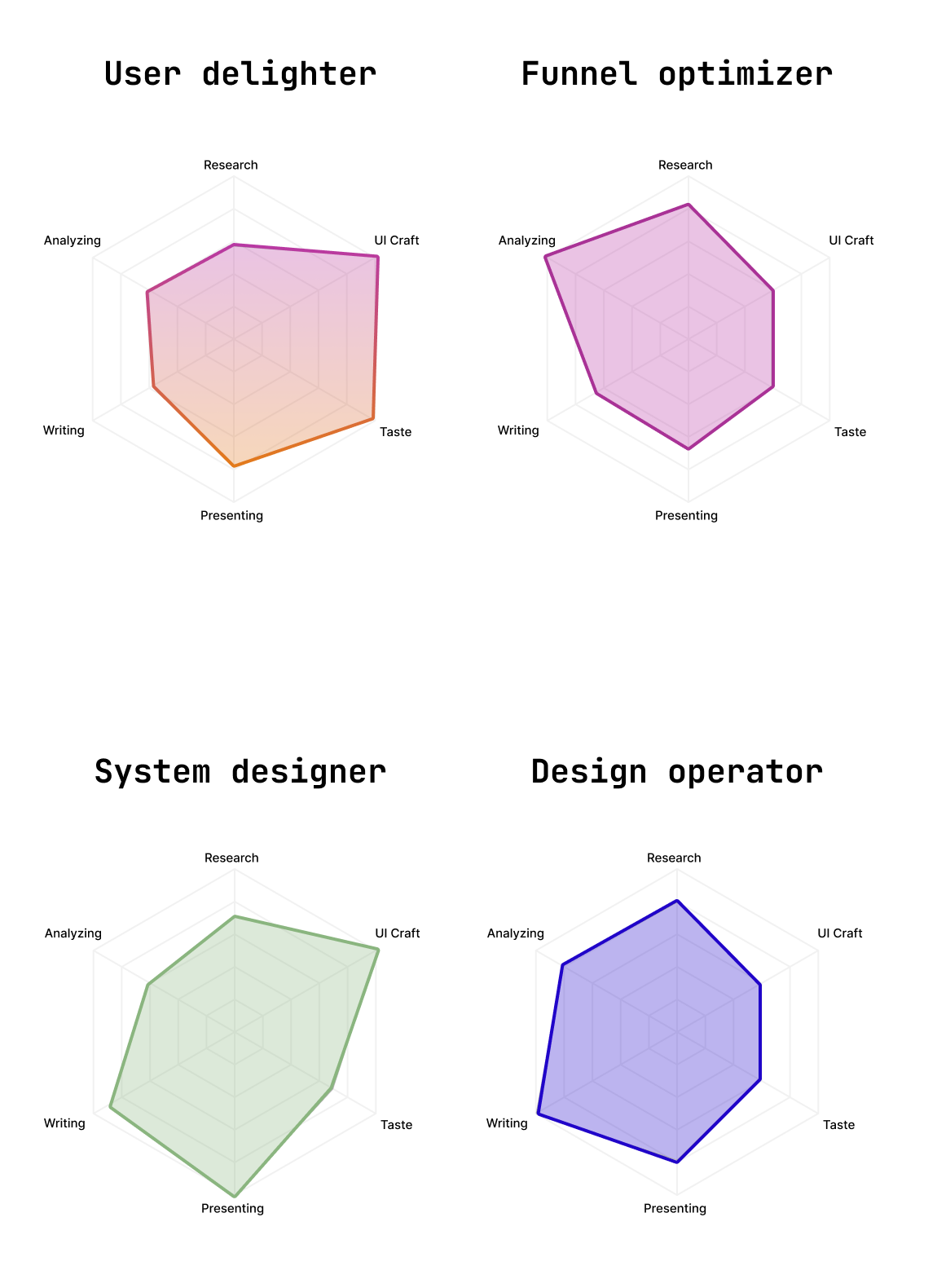
The User Delighter spikes on Taste and UI Craft. They’re the ones who make users say “oh, that’s nice.” Every team needs at least one.
The Funnel Optimizer lives in Analyzing and Research. They don’t care if the button is beautiful. They care if it converts. Pair them with a User Delighter and watch the magic happen.
The System Designer is balanced across Analyzing, Writing, and Presenting. They build the structures that let everyone else move faster: design systems, documentation, processes.
The Design Operator is heavy on Analyzing, Writing, and Presenting, lighter on Taste. They’re the ones who keep the trains running. They run the critiques, write the briefs, present to leadership.
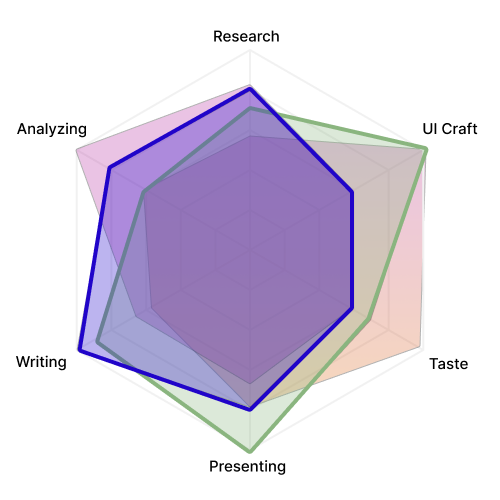
Now overlay all those polygons on one chart.
A well-built design team fills the entire hexagon. Not because every person does everything, but because the gaps in one person’s shape are covered by someone else. That’s the whole point. You’re not hiring clones. You’re assembling coverage.
When I was growing the team at Mynd, this framework helped me figure out what we were missing before writing a single job description. We had plenty of UI Craft and Taste. We were starving for Analyzing and Research. So that’s what we hired for. Simple. (Well, hiring is never simple. But that's a topic for another post.)
I'm writing this from the future (2026, two years after this original article was written).
I still don’t know exactly what this means, and it will likely take the industry some time to come to some kind of consensus. But AI just changed the shape of the hexagon.
Writing, Analysis, and a lot of Research can be greatly augmented using large language models, allowing AI fluent designers to perform those tasks with 10x efficiency. So I have an inkling that over the next year we will see AI fluency arise as a major pillar of measuring designer effectiveness.
P.S. This is also partially why I believe that there will come a time when designers will be able to ship simple products without any need for programmers and engineers, but that's a topic for another heated discussion.